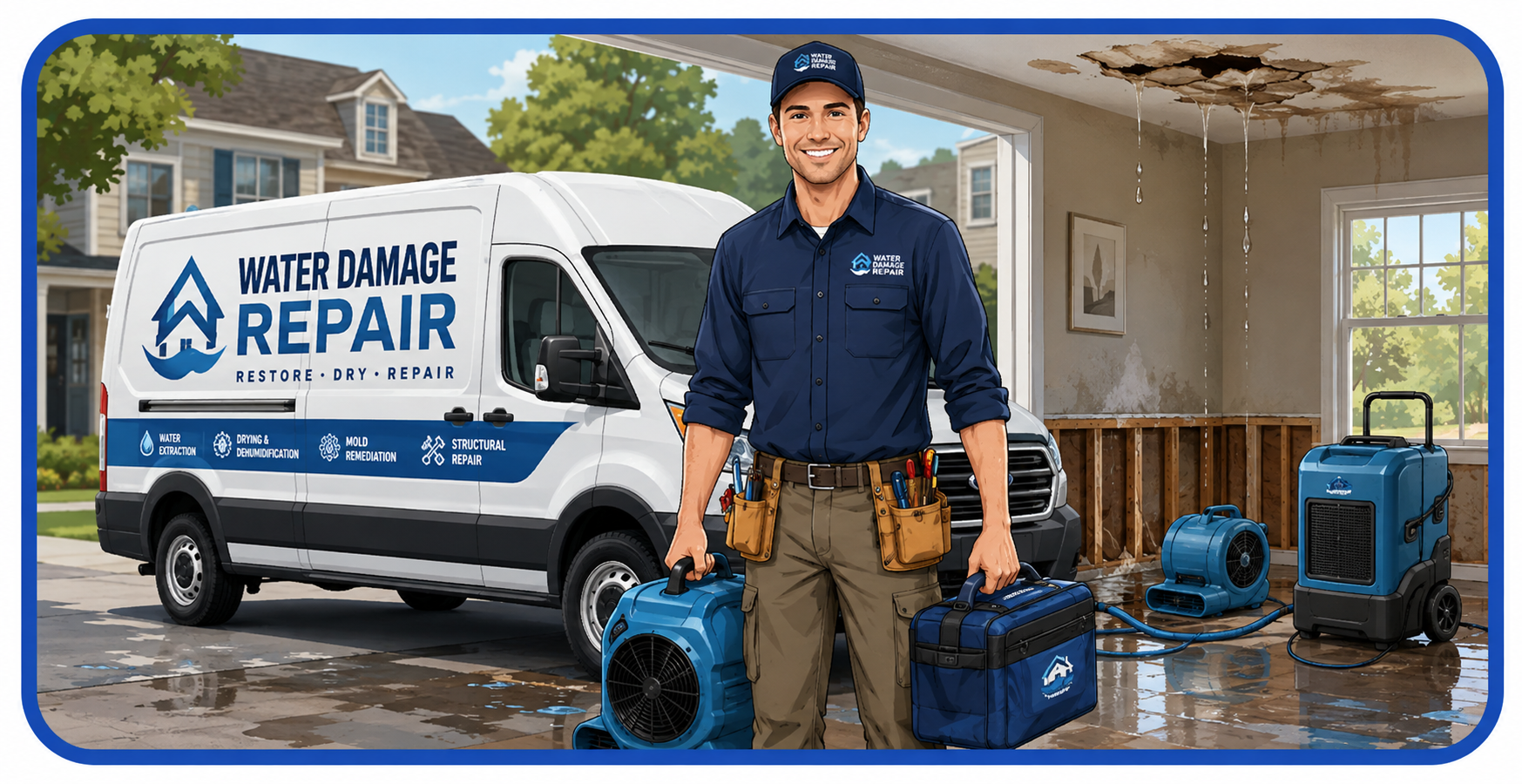
Our Fulton Structural Drying Scope
COS Water Damage Restoration's Fulton structural drying service covers every assembly type and situation encountered in a water damage event — from standard floor and wall assemblies to hardwood systems, crawlspace framing, and multi-story moisture migration events.
Wall Framing & Drywall Cavity Drying
The most common drying failure in Fulton water damage projects is a wall framing cavity left with elevated moisture content after surface materials are dry. Our Fulton team uses calibrated cavity access — typically 1-inch drill holes at the base of the wall framing cavity — to introduce directed airflow from high-velocity air movers into the stud bay, paired with LGR dehumidification to extract the evaporated moisture. Moisture readings at framing sensor points confirm completion. Access ports are patched and filled after the program completes, typically leaving no visible trace of the access procedure.
Subfloor & Hardwood Assembly Drying
Subfloor assemblies — OSB or plywood sheathing over floor joists — and hardwood flooring systems require targeted drying approaches because of their density and their tendency to cup, buckle, or swell when dried too aggressively or left wet too long. Our Fulton drying crew evaluates hardwood flooring species and moisture content before recommending drying-in-place versus removal, and when drying in place is appropriate, we use floor drying mats that direct conditioned air against the top face of the hardwood under controlled pressure — accelerating evaporation while minimizing the differential drying stress that causes cupping.
Crawlspace & Below-Grade Drying
Crawlspace drying in Fulton properties is complicated by limited access, typically poor natural ventilation, and the presence of vapor barriers that may trap moisture against wood framing. Our Fulton below-grade drying team is equipped with compact high-velocity air movers that fit through standard crawlspace access hatches, portable LGR units configured for below-grade operation, and moisture meters suitable for sub-surface readings at joist and beam locations. Vapor barrier condition is evaluated and re-secured after drying if disturbed during the process.
Ceiling & Overhead Assembly Drying
Water that migrates down from an upper floor or a roof intrusion in a Fulton property saturates ceiling drywall and the framing above it — areas that are impossible to reach with standard floor-level equipment. Our Fulton team installs ceiling injection ports and directs positive-pressure airflow through ceiling cavities, combined with LGR dehumidification of the affected room air space. Ceiling drywall that cannot be dried to target moisture content is removed — rather than left to become a mold substrate — and documented in the scope for replacement.
Commercial & Multi-Room Drying Programs
Large water events in Fulton commercial or multi-family properties may affect dozens of rooms across multiple floors — requiring coordinated equipment staging, airflow balancing between spaces, and readings management across a large number of sensor points simultaneously. Our Fulton commercial drying team uses scaled equipment deployment and a project management approach that tracks readings and equipment across the full property footprint, adjusting equipment placement and settings daily based on the reading data from each zone.
Mold Prevention Monitoring
Every active structural drying program in Fulton is also a mold prevention program — because the conditions that support mold growth (elevated moisture content in organic materials and elevated relative humidity in the air space) are exactly the conditions a drying program is designed to eliminate. Our daily reading sessions include assessment of the ambient RH and temperature conditions in each drying zone against the threshold conditions that support mold colonization. If readings suggest an elevated mold risk — particularly in projects where extraction was delayed — we address it proactively with targeted antimicrobial treatment during the active drying program.